A cosmetic tattoo touch-up is a follow-up session that adjusts or refreshes colour you already have, and most people need two kinds: one soon after the first session has healed, and others every so often as the colour softens. The general pattern is well understood across studios. What nobody can tell you in advance is exactly when your own colour will need attention, because your skin, the area tattooed, the sun and your habits all change how quickly it fades. That gap between a general pattern and your own face is why so many people end up guessing.
So this guide gives you the usual ranges, shows you how to judge your own colour instead of relying on the calendar and explains what to expect in the appointment. PhiBeauty is a beauty salon and cosmetic tattoo studio in South Yarra, not a medical clinic, and everything here is general information rather than medical advice.
Quick answer: when do you need a cosmetic tattoo touch-up?
Most people have a first touch-up, called a perfecting session, about four to eight weeks after the first appointment, once the skin has healed. After that, studios commonly suggest refreshing the colour every one to three years as it softens. The best guide is how your colour looks, and your artist will confirm the timing that suits you.
Cosmetic tattoo touch-up at a glance
| Touch-up | Usual timing | What it is for |
|---|---|---|
| Perfecting session | Often about four to eight weeks after the first session, once the skin has healed | Adjusts colour and shape based on how your skin has healed |
| Colour boost | Commonly every one to three years, depending on the area and the person | Refreshes colour that has softened over time |
| Earlier touch-up | Any time colour looks patchy or faded sooner than expected | Evens out uneven or light areas |
| Colour correction | Only if needed, and it can take more than one session | Changes colour that healed differently from what was planned |
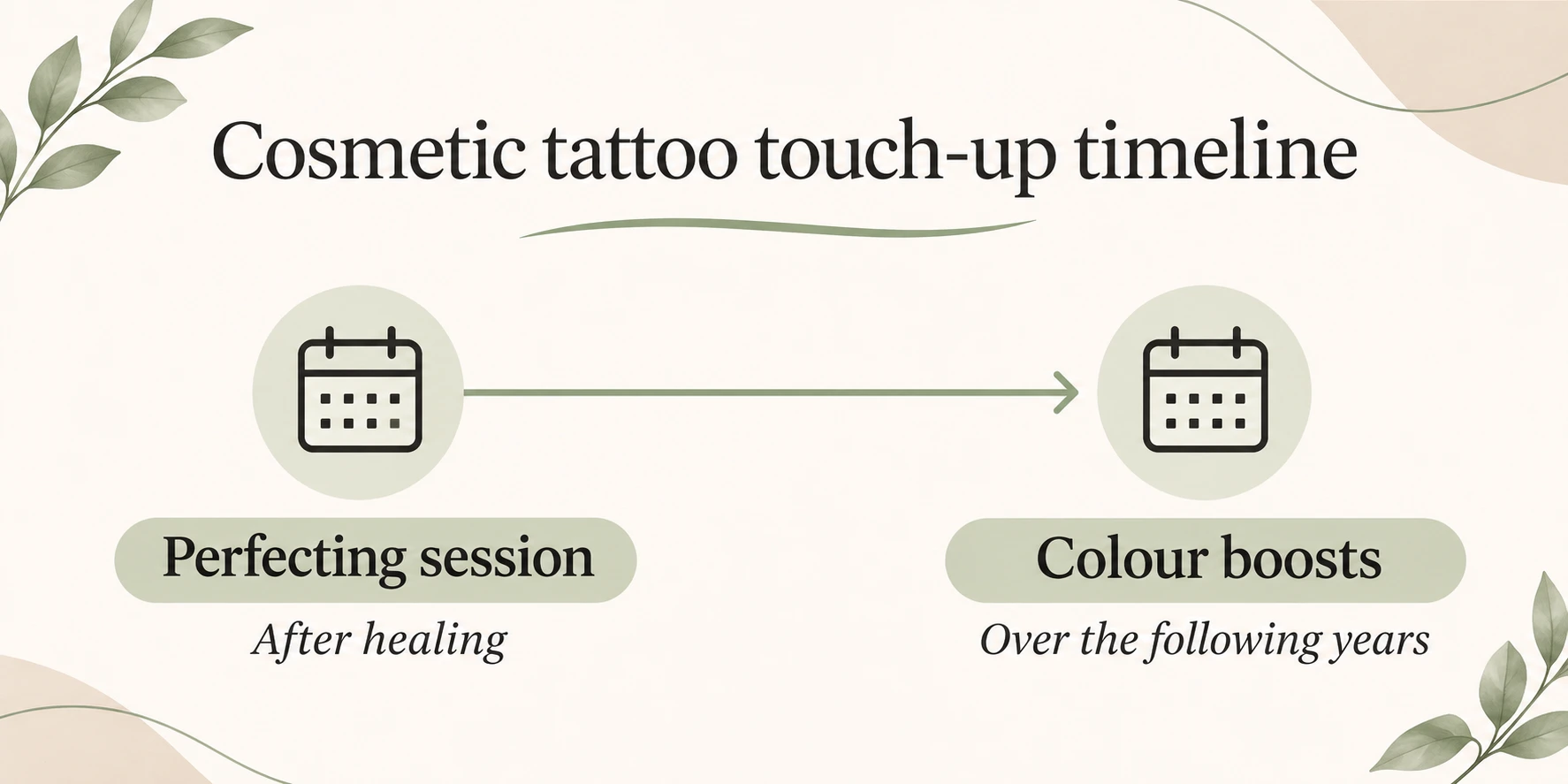
Timeline showing a perfecting session after healing and colour boosts over the following years
The two kinds of touch-up
Think of the first session as the foundation and the touch-up as the fine tuning. Because cosmetic tattoo colour sits in the upper layers of the skin, it is designed to soften gradually rather than stay exactly as it was on day one. That makes a touch-up a normal, expected part of having it done, not a sign that something went wrong.
Perfecting session
This is the follow-up after your first session has healed. Skin never takes colour in quite the same way across a whole area, so some spots can heal lighter, softer or patchier than others. At a perfecting session your artist looks at the healed result and adds colour or adjusts the shape where it’s needed. Some people need only small changes. A good artist reviews your healed result honestly rather than assuming every area needs more.
Colour boost
This is the refresh that comes later, when the colour has softened over time. It is also called a colour boost or a maintenance touch-up. Its job is to bring back the depth and definition you liked, not to change the design.
Touch-ups by area: brows, lips and eyeliner
The idea is the same everywhere, but what a touch-up looks like depends on the area. Here’s what people commonly notice and ask their artist to adjust.
Brows
Brows are the area most people refresh. After healing, the usual changes are small gaps where the colour healed lighter, a tail or front that looks softer than the rest and a tone that has drifted warmer or cooler. A perfecting session fixes these early on. Later colour boosts tend to be about restoring depth and keeping the shape crisp. Hair-stroke brows and powder or shaded brows soften differently, so the timing your artist suggests may not be the same for each.
Lips
With lips, people usually notice the colour looking lighter than they remember, or the edge of the lip losing some definition. Lips are soft, move constantly and see a lot of sun, so colour can soften sooner for some people. If you get cold sores, tell your artist before any lip touch-up, and speak with your GP, because lip procedures can trigger them.
Eyeliner
Eyeliner is often the slowest to soften, and many people only notice the change when the line looks thinner or less defined along the lash edge. Because it sits so close to the eye, this is an area where you should choose your artist carefully, follow their instructions to the letter and tell them about anything that feels off.
What a touch-up can and can’t do
It helps to go in with realistic expectations, so you’re not disappointed.
- A touch-up can even out patchy areas, bring back depth and definition and refine the shape slightly. It can also give your artist a second chance to look at how your skin has actually taken the colour and adjust to it.
- A touch-up can’t promise how long the colour will last, because that depends on your skin, the sun and your habits. It can’t completely redesign a shape, and some bigger changes may need more than one session. And it can’t replace healing time. If your skin is still settling, or irritated, your artist may ask you to wait, because working on skin that hasn’t recovered gives a poorer result. If you’re unhappy with how something looks, say so at the appointment and ask what is realistic, rather than assuming more colour is always the answer.
How often do you need a touch-up?
There’s no single answer, because colour fades at a different pace on every person and every area. The table shows the ranges studios commonly quote. Treat them as a rough guide only, because they vary between studios and nobody can promise a result.
| Area or style | Refresh commonly quoted | Note |
|---|---|---|
| Hair-stroke brows (microblading) | About 12 to 18 months | Fine strokes can soften earlier, especially on oilier skin |
| Powder or shaded brows | About 18 months to 2 years | Soft, filled colour tends to fade more evenly |
| Lip blush | About 1 to 3 years | Sun and everyday movement can soften lip colour sooner for some people |
| Eyeliner | About 2 to 3 years or longer | Often the slowest to fade, because it has the least exposure |
For more on brows, see our guide on how long an eyebrow tattoo lasts. You can also read about our eyebrow tattoo services and eyeliner tattoo.
Is a yearly touch-up necessary?
Not necessarily. Some studios suggest a yearly colour boost, but the right time depends on how your own tattoo looks. A simple habit works better than a fixed date: check your colour once a year, and book when you notice it softening, rather than waiting until it has gone. If you’re unsure, ask your artist to look at your colour in person. They can tell you whether you’re due a refresh now or whether it’s worth waiting a few more months. Checking at the same time each year is an easy way to keep track.
Signs your colour needs refreshing
You don’t need to wait for a set date. Consider booking sooner if you notice any of these:
- The colour looks clearly lighter or less defined than it did when healed
- Patchy or uneven areas, such as gaps in the brows or lighter parts of the lips
- The shape looks softer or less sharp than you remember
- The tone has shifted and looks cooler or warmer than before
- You’re filling the area in with makeup more than you used to
- Photos from a few months ago look noticeably stronger than the mirror does today
A useful trick is to take a photo every few months in the same natural light, so you can see slow changes that are hard to spot day to day.
“Don’t wait until your colour has completely gone. If you notice it softening, or one side looking lighter than the other, that’s a good time to get in touch. It’s much easier to look at what you have and decide together than to guess.” Sarah, cosmetic tattoo artist at PhiBeauty
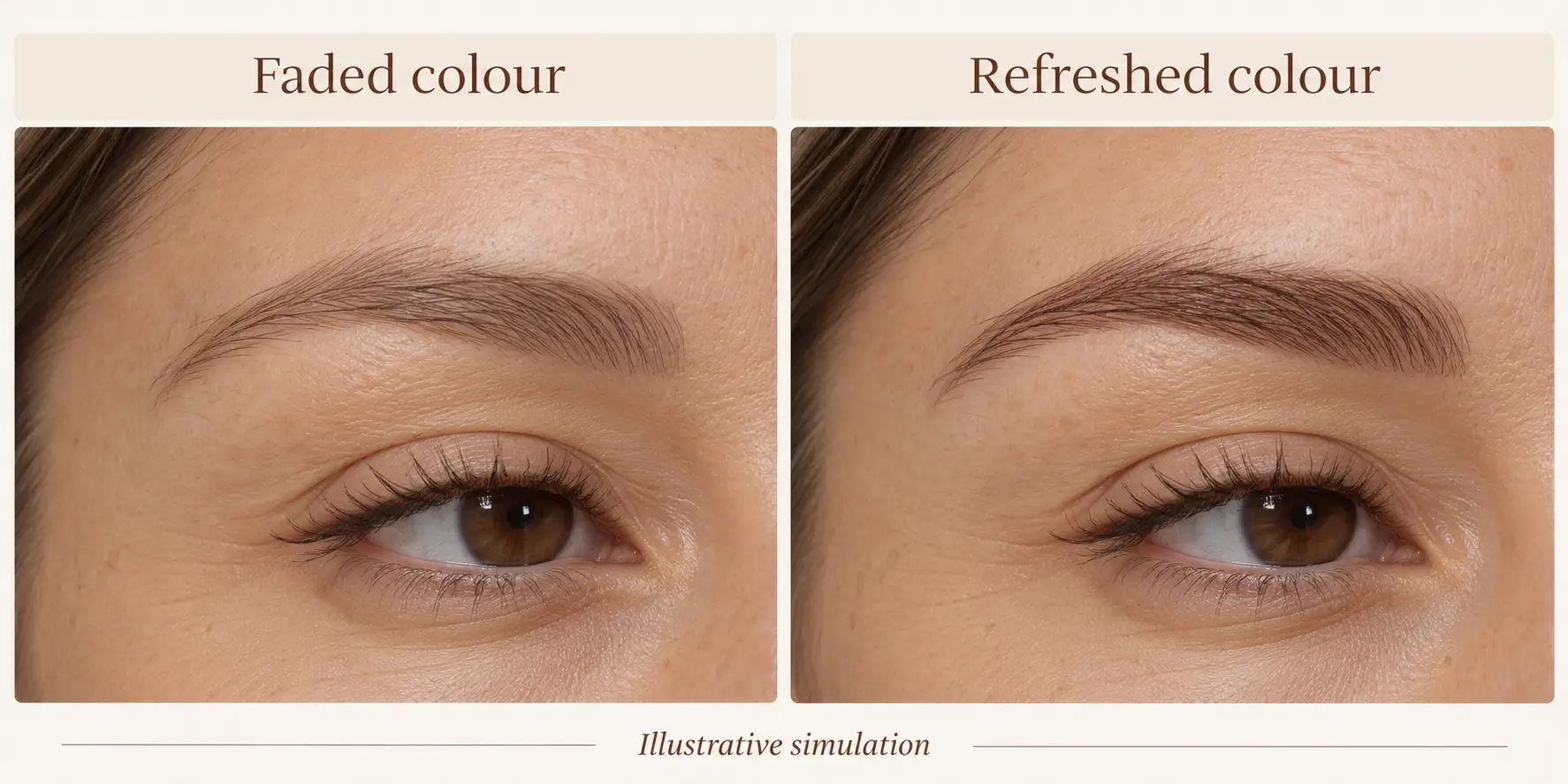
Side-by-side comparison of a faded cosmetic tattoo and a freshly refreshed one
What makes cosmetic tattoo colour fade faster
Fading is natural, but some things speed it up, and knowing them helps colour stay fresher for longer.
- Sun and solariums. Sun is one of the biggest reasons colour softens, so protect the area once it has healed.
- Active skincare. Exfoliants, acids, peels and retinol-type products on or near the area can lighten colour faster, so keep them away unless your artist says otherwise.
- Skin type. Oily or very porous skin may hold colour less well, especially for fine hair-stroke brows.
- The area itself. Places that move or rub a lot, such as the start of the brows or the lips, can soften sooner.
- Pigment shade. Some shades fade faster or shift in tone as they soften, and your artist can explain this when choosing colour.
- Aftercare slips. Picking, rubbing or ignoring your artist’s instructions while healing can lift colour.
- Health and medicines. Some conditions and medicines may affect how skin holds colour, so tell your artist and ask your GP if you’re unsure.
How to prepare for your touch-up
A little preparation makes the appointment smoother and helps your artist see your colour as it really is.
- Follow your studio’s pre-appointment instructions. They may differ from what another studio told you, and your artist’s advice always comes first.
- Take photos beforehand. Photos of your colour as it healed, and a few from the last few months, help your artist see how it has changed.
- Note what you’d like changed. Is it depth, shape, tone or a particular patchy spot? Having an answer saves time.
- Tell your artist about any changes. That includes new medicines, a recent peel or laser, sunburn, pregnancy or any skin reaction since your last visit.
- Avoid sun and strong skincare on the area beforehand. Irritated or sunburnt skin may mean your appointment has to be moved.
- Arrive with the area clean. Your artist will explain whether you should come without makeup on the area.
- Leave enough time afterwards. Don’t book a touch-up right before a big event, because the skin needs to settle.
What happens at a touch-up appointment
Touch-ups are often shorter and more targeted than the first session, although every studio works a little differently.
- Review of the healed result. Your artist looks at how the tattoo has healed and talks through what you’d like adjusted.
- Health check-in. Expect to be asked again about your health, recent skincare, sun exposure and medicines, including cold sore history if the lips are involved.
- Information and consent. The studio should go through the risks and safeguards with you again before starting and update your records.
- Targeted tattooing. Your artist adds colour only where it’s needed, using new sterile equipment.
- Aftercare. You’ll be given instructions again, because the skin needs to settle after every session.
“A touch-up isn’t starting from scratch. We look at what’s there, talk about what you’d like changed and only work where it’s needed. I’d rather you leave happy with a small adjustment than do more than you need.”
Sarah, cosmetic tattoo artist
Appointment length varies with the area and how much work is needed, so ask your studio when you book. A short, targeted touch-up is common, but a larger refresh or a colour correction can take longer.
Healing and aftercare after a touch-up
After a touch-up, your skin follows the same general pattern as after the first session, and your artist’s written instructions always come first. For the full detail, see our guides on lip blush healing, lip tattoo care and eyebrow tattoo care. If you’d like to know what lip blush is before you decide, our lip blush guide explains it.
In general, expect the area to look a little stronger at first and then soften as it settles, just as it did after your first session. Keep it clean, don’t pick or rub it, protect it from the sun and avoid active skincare until your artist says it’s fine. If something doesn’t look or feel right, contact your artist, or your GP if it’s a health concern.
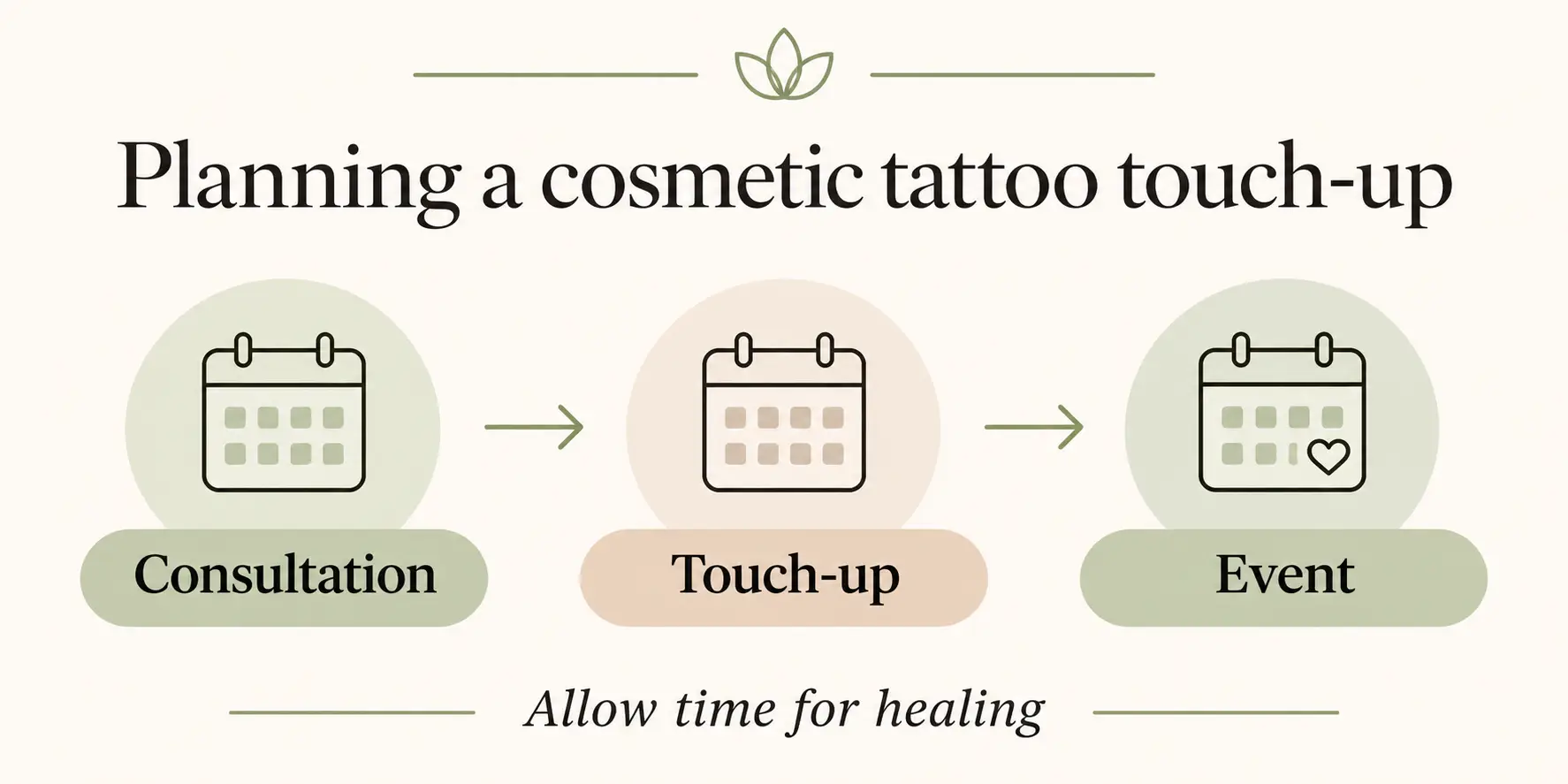
Calendar-style guide for booking a cosmetic tattoo touch-up before an event
Booking at the right time, and what to ask about cost
Timing matters more than most people expect, because the skin needs time to settle after a session. Plan around your calendar rather than squeezing a touch-up in.
| If you have | Plan like this |
|---|---|
| A wedding or photoshoot | Book well ahead so your skin has healed before the day, and avoid a session in the last few weeks |
| A holiday with strong sun | Leave the touch-up until afterwards, or book early enough that the area has healed first |
| A first touch-up due | Book your perfecting session before you leave your first appointment so it falls in your studio’s window |
Prices vary between studios and artists, so a single figure wouldn’t be reliable. What matters is understanding the policy before you start. Ask whether the perfecting session is included in the first price, how long you have to book it, what a later colour boost involves and whether colour correction is charged separately.
“If you have something important coming up, book earlier than you think you need to. The skin needs time to settle after a session, and you don’t want to be rushing to finish before the day.”
Sarah, cosmetic tattoo artist at PhiBeauty
Who should check first, and Victorian requirements
Check with your GP first
A touch-up is another tattoo procedure, so the same health checks apply as for your first session. Speak with your GP before booking if any of these apply:
- You’ve had cold sores and the touch-up is on your lips
- You have a cold sore, an infection, sunburn or irritated skin in the area, in which case the appointment needs to wait
- You’re pregnant, breastfeeding or planning a pregnancy, because many studios advise waiting
- You have a health condition or take medicines that can affect healing or bleeding
- You’ve had a peel, laser or another skin procedure near the area recently
- You’ve reacted to tattoo pigments or skincare products before
See your GP promptly if you notice spreading redness, heat, swelling that is getting worse, discharge, increasing pain, a fever or blisters. If you have trouble breathing or swelling of the face or throat, call 000 immediately. PhiBeauty is a beauty salon and doesn’t provide medical services.
What Victoria requires
A touch-up is a tattoo procedure, so the same rules apply as for your first session. In Victoria, tattooing businesses must be registered with their local council, and you must be 18 or over, because it is illegal to tattoo anyone under 18, including cosmetic tattooing, even with parental consent. If you’re having work done elsewhere refreshed, tell your new artist, because they will want to see the original work and may take a different approach.
Common touch-up mistakes
- Skipping the perfecting session. The first result is rarely the final one.
- Booking too early. If the skin hasn’t healed, your artist can’t see your true colour.
- Waiting until the colour has gone. Booking while some colour remains gives your artist more to work with.
- Using strong skincare on the area. Exfoliants, acids and retinol-type products can lighten colour faster.
- Ignoring sun protection. It’s one of the simplest ways to keep colour fresher for longer.
- Choosing a studio on price alone. Registration, hygiene and experience matter far more than a low price.
Cosmetic tattoo touch-ups at PhiBeauty
PhiBeauty is a beauty salon and cosmetic tattoo studio at G2/657 Chapel St, South Yarra VIC 3141, with eyebrow, eyeliner and lip tattooing. If you’re not sure whether you need a touch-up, or when, book a consultation with Sarah and she’ll look at your colour and talk you through your options. You can read more about our lip tattoo services in South Yarra. To book, call +61 452 235 811.
Conclusion
A touch-up is a normal part of having cosmetic tattooing. Plan your perfecting session for about four to eight weeks after the first appointment, expect to refresh the colour every one to three years and watch for the signs that say your colour is softening. Protect the area from the sun, keep strong skincare away from it and choose a registered Melbourne studio you trust. If you’re not sure whether you need a touch-up, a quick consultation will tell you.
Key points to remember:
- A touch-up adjusts and refreshes colour. It’s a normal, expected part of cosmetic tattooing.
- The perfecting session is usually about four to eight weeks after the first appointment, once the skin has healed.
- Colour boosts are commonly suggested every one to three years, depending on the area, your skin and your lifestyle.
- Sun, active skincare, oily skin and everyday movement can make colour fade faster.
- If your colour looks patchy, lighter or changed, book sooner rather than later.
- A touch-up is a tattoo procedure, so the same Victorian rules, risks and health checks apply.
- Before you start, ask your studio about its touch-up policy and cost.
This article is general information only and is not medical advice. PhiBeauty is a beauty salon and does not provide medical services. Individual results, healing and longevity vary.
Sources
- Victorian Department of Health. Body art and tattoo businesses: infection prevention and control.
- Better Health Channel (Victorian Government). Tattoos.
- City of Greater Geelong. Tattooists.
- PMUHub. Lip blush facts you should know before booking.
- W Magazine. All your questions about lip blushing, answered.