The hydrating serum vs moisturiser question trips up a lot of people, and it is easy to see why. Both go on after cleansing, both promise comfortable skin, and both come in similar-looking bottles and jars. It is fair to wonder whether one is doing the other’s job.
They are not the same, and the difference is practical. A serum is a thin layer that adds water-binding ingredients. A moisturiser does more: it hydrates, softens and slows the loss of water from the skin. Which one you need depends on how your skin feels by mid-afternoon, not on how many steps a routine is supposed to have.
Below, we explain the difference, help you decide, and then introduce some options from our range. Where we mention our own products, we stick to what the product titles and pages show and leave ingredient details to the labels, so you can check each one yourself before you buy.
Hydrating Serum vs Moisturiser: The Quick Answer
If you can only use one, use a moisturiser. It hydrates and helps hold moisture in, so it is the more complete step. Add a hydrating serum underneath when your skin still feels tight after moisturising, or when rich creams feel too heavy. Skip the serum if your skin is comfortable without it. Different days can call for different answers, especially when the weather changes. If your skin stings or looks red after you add something new, stop and simplify.
Key Takeaways
- A hydrating serum adds a light layer of water-binding ingredients. A moisturiser hydrates and helps keep moisture in.
- If you can only buy one, a moisturiser is usually the more complete choice.
- Serum goes on after cleansing and before moisturiser, never the other way round.
- Tightness after moisturising, or a cream that feels too heavy, are the usual reasons to add a serum.
- A few drops of serum and a thin layer of moisturiser are enough.
- Add one new product at a time, so you can tell what is helping.

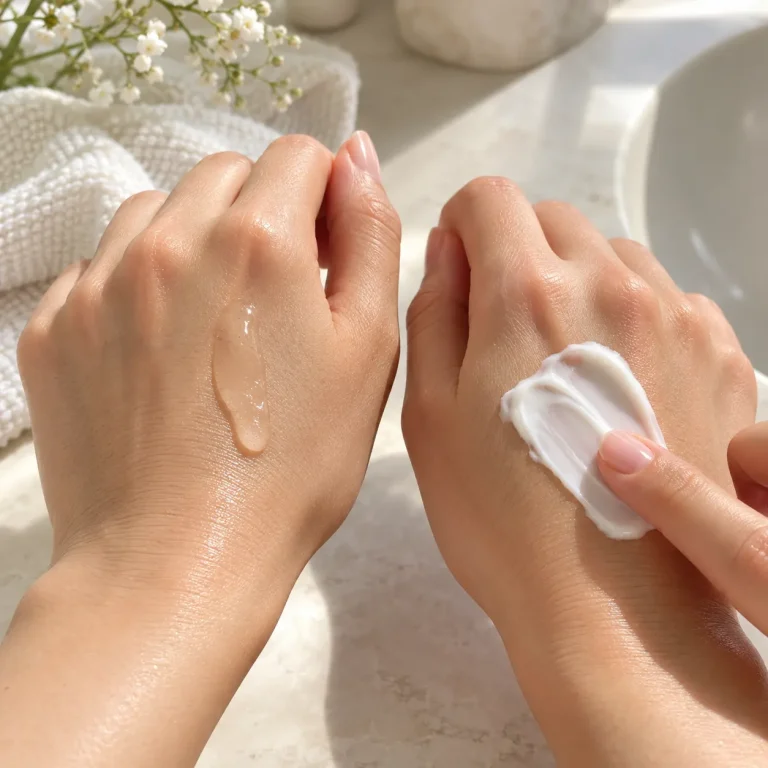
Texture of a hydrating serum compared with a moisturiser
What Each One Actually Is
Hydrating Serum
A hydrating serum is a lightweight liquid or gel applied after cleansing. Its focus is water. Most are built around ingredients that attract and hold water, such as hyaluronic acid or glycerin, in a thin base that absorbs quickly. Some serums are a gel and others a runny liquid, and both are normal.
Moisturiser
A moisturiser is a lotion, gel-cream or cream that does several jobs at once. It hydrates, softens the surface of the skin and slows water loss. Many also contain ceramides or plant oils, which is why they feel more substantial than a serum. Choose the weight that feels comfortable on your skin, not the heaviest one on the shelf.
Where They Differ
The simplest way to separate them is by job.
| Hydrating serum | Moisturiser | |
|---|---|---|
| Main job | Add water | Hydrate and hold moisture in |
| Texture | Light liquid or gel | Lotion, gel-cream or cream |
| Order | First, after cleansing | Second, over the serum |
| Needed? | Optional | Usually yes |
What Each One Does for Hydration
Adding Water to the Surface
Hyaluronic acid and glycerin are humectants, which means they attract and bind water. In a serum, they sit in a base that spreads easily and never feels heavy. They help the outer layer of skin hold more water, which many people notice as a softer, more comfortable feel. How long that feeling lasts depends on the formula and on what you put over it.
In a 2012 review of hyaluronic acid in skin, Papakonstantinou and colleagues describe it as the main molecule behind skin moisture, because it can bind and hold large amounts of water. That research looks at the hyaluronic acid skin makes itself, not at serums.
Holding It In
Moisturisers usually add two more types of ingredient. Emollients soften and smooth the surface, and occlusives form a light film that slows water loss. Together with humectants, they hydrate and help keep that moisture where it belongs. This is why a moisturiser is the step most routines rely on, and why heavier creams feel richer: they contain more of these ingredients.
Why One Alone May Not Be Enough
A serum on its own can feel lovely for an hour and then fade, because nothing is holding the water in. A light moisturiser on its own can leave some skin feeling tight. Using both covers both jobs, but only if your skin needs it. Climate matters too. Skin that is comfortable in a humid Melbourne summer may want a richer layer once heating dries the air in winter, and the reverse is also true.
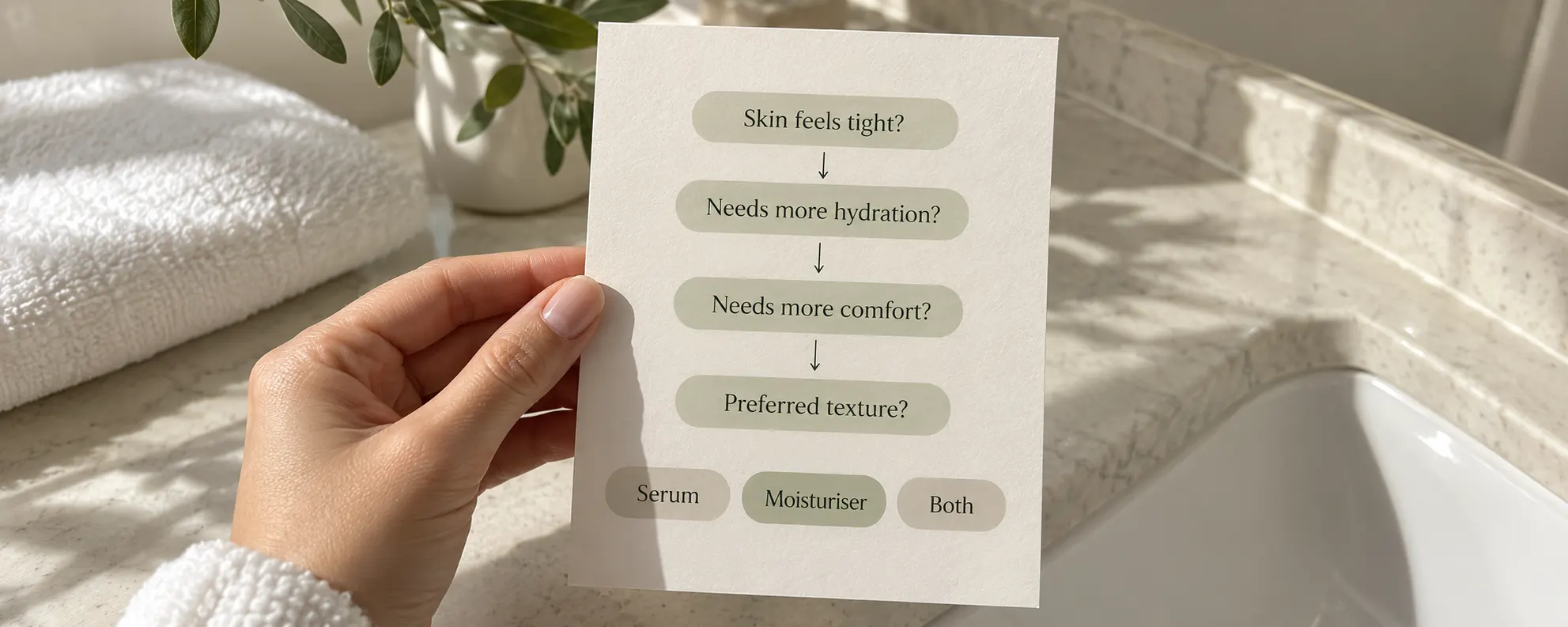
Hydrating serum vs moisturiser self-check
Hydrating Serum vs Moisturiser: Do You Need Both?
Answer these four questions about how your skin feels, not about how many products you own.
1. Does Your Skin Feel Tight After Moisturiser?
If your skin still feels tight or looks dull an hour after moisturising, it may want more water-binding ingredients underneath. A hydrating serum is a reasonable thing to try. If the tightness eases after a week or two of using both, you have your answer. If it does not, simplify and speak with your GP or pharmacist.
2. Does a Rich Cream Feel Heavy?
If thick creams feel heavy or greasy, a lighter moisturiser plus a hydrating serum can be more comfortable than one rich product. The serum supplies the water-binding layer, and a gel or lotion finishes the job without the weight. Gel-creams are a common middle ground.
3. Do You Want a Simple Routine?
If you prefer fewer steps, a good moisturiser is usually enough. A cleanser, a moisturiser and sunscreen in the morning is a perfectly good routine, and many people never need more. Add a product only when your skin gives you a reason to, and let that reason be something you can see or feel.
4. Is Your Skin Sensitive or on Active Medication?
If your skin is sensitive, or you use prescription skin medication, keep things simple and ask your GP or pharmacist before adding anything new. Test a small area first.
The rule: if you answered yes to question one or two and no to question four, adding a hydrating serum is reasonable. If you answered yes to question three or four, start with a moisturiser alone. If your answers are mixed, take the simpler option first and revisit after a couple of weeks. You can always add a serum later, but it is harder to tell what is working when you start with everything at once.
Which One Suits Your Skin
- Dry Skin: Dry skin often does best with a moisturiser that has a richer texture. A hydrating serum can sit underneath if skin still feels tight, but the moisturiser does most of the work. Rich textures tend to feel best in cooler months, so you may want a lighter version in summer.
- Oily or Breakout-Prone Skin: Oily skin can still feel short of water, so skipping moisturiser is not always the answer. A light gel moisturiser may be enough, and some people like a serum under it. Choose lighter textures and see how your skin feels after an hour. A fragrance-free, light formula is a sensible starting point. Our acne guide covers the wider picture.
- Combination Skin: Combination skin can mix the two. You might use a serum all over, a lighter moisturiser on oilier areas and a slightly richer one on drier areas. Adjust the amount by zone rather than changing the whole routine. Judge the result by how your whole face feels after an hour, not by one patch.
- Sensitive Skin: Sensitive skin reacts to fragrance and to too many changes at once. Start with a gentle moisturiser and add a serum only if your skin still feels short of water. If you have eczema or rosacea, ask your GP or pharmacist first. Introduce anything new during a quiet week, not just before an event.
If You Can Only Buy One
If your budget allows only one product, choose the moisturiser. It covers hydration and moisture retention in one step, which makes it the more complete product for most routines. A hydrating serum is a useful addition, not a replacement, and you can add it weeks later. A moisturiser you use every day does more for your skin than a better-sounding product that stays in the drawer.
Start by asking what is missing from your routine today. If you have no moisturiser, buy one first. If you already have one you like and your skin still feels tight, a serum fills the gap. If your moisturiser is simply not suiting you, switching to a better-matched one is often more useful than layering a serum on top. When you are ready, browse our moisturiser range.

How to layer a hydrating serum and moisturiser
How to Layer Them
If you use both, the order matters more than the amount.
- Cleanse your face and leave it slightly damp.
- Press a few drops of hydrating serum into the skin.
- Wait until it no longer feels wet. Light gels settle quickly, while thicker textures take a little longer.
- Apply your moisturiser over the top.
- In the morning, finish with sunscreen.
Morning and Night
In the morning, the order is cleanse or rinse, serum, moisturiser, then sunscreen. At night, use the same order without the sunscreen. Some people use a serum only at night, or only in the morning. Either is fine, and there is no rule that you must use it twice a day.
How Much to Use
More product does not mean more hydration. A thin layer of serum under a moisturiser feels better than a thick one. If your skin feels sticky, or the layers roll off when you apply the next step, you have probably used too much. Start with less than you think you need and add a drop if it feels like too little.
If a Product Pills
Pilling means the product balls up on the skin. It usually points to too much product or too little patience between layers. Use less next time and let each layer settle before the next.
| Your answers | What it suggests |
|---|---|
| Yes to 1 or 2, and no to 4 | Hydrating serum plus moisturiser |
| Yes to 3 | Moisturiser only |
| Yes to 4 | Moisturiser only, with one new product at a time |
| No to all four | A moisturiser is enough |
Hydrating Serums at PhiBeauty
Here are three hydrating serums from our range, in no particular order. Each one goes on after cleansing and before moisturiser, on slightly damp skin. Check the product page for directions and the ingredient list before you choose, especially if you avoid fragrance.
What to Look for in a Hydrating Serum
Read the ingredient list for humectants such as hyaluronic acid, glycerin or panthenol (a form of vitamin B5), which attract and hold water. Decide whether you prefer a gel or a thinner liquid, and whether a dropper or a pump suits you. If you avoid fragrance, check that it is not on the list. Before the first full use, test a small area for a couple of days, because even gentle formulas can disagree with some skin. Then add the serum on its own, so any reaction is easy to trace.
Medik8 Hydr8 B5 30ml
Our range lists this alongside Medik8 Hydr8 B5 Intense 30ml, so you can open both pages and compare the two from the same brand. Read how each is described before you choose.
Fillmed HAB5-Hydra Serum 30ml
Fillmed also has a Cleansing Oil 200ml and a Re-Time Serum 30ml in our range, which suits anyone who likes to build a routine from one brand. Open the page to confirm the full ingredient list.
Hyaluronan NAG Liposomes 20ml Hydration Serum
At 20ml, this is the smallest of the three serums, which makes it a lower commitment if you are trying a serum for the first time. Its listing calls it a hydration serum.
Moisturisers at PhiBeauty
Moisturisers at PhiBeauty
These three are also from our range, in no particular order, and all three are listed as moisturiser-range products on our site. A moisturiser works with or without a serum underneath, so choose by texture and by what the ingredient list says about fragrance.
What to Look for in a Moisturiser
Match the texture to your skin and the season. A lotion or gel-cream suits oilier skin and warmer months, while a cream suits drier skin and cooler months. Check whether the product contains fragrance, and whether it lists sunscreen. Even then, read the label, because a moisturiser without SPF still needs sunscreen over the top in the morning. A pump keeps fingers out of the product, though a jar works fine too. Give a new moisturiser a couple of weeks of steady use before judging it, unless it irritates your skin, in which case stop.
Dr Spiller Hydro Collagen Cream 50ml
Dr Spiller has a Dehydration category on our site, which is a handy place to see more of the brand’s creams side by side.
Dr Spiller Collagen Aqua Plus 50ml
This shares both the brand and the 50ml size with the cream above, so you can compare the two pages like for like. The names alone do not say which is lighter, so check the texture on each page.
Dermaceutic Hyal Ceutic 40ml
The “Hyal” in the name points towards hyaluronic acid, but confirm the formula and where the brand places it in a routine on the product page, since we list it in our moisturiser range. At 40ml, it is also the smallest of these three.
Hydrating Serum vs Moisturiser: Our Products Side by Side
Use this table to compare the products above at a glance. Sizes come from the product titles on our site. It shows where each product fits in a routine, not which one is better. Each product page has the full directions and ingredients, and availability can change, so check stock there.
| Product | Size | Type | Where it fits |
|---|---|---|---|
| Medik8 Hydr8 B5 | 30ml | Hydrating serum | After cleansing, before moisturiser |
| Fillmed HAB5-Hydra Serum | 30ml | Hydrating serum | After cleansing, before moisturiser |
| Hyaluronan NAG Liposomes Hydration Serum | 20ml | Hydrating serum | After cleansing, before moisturiser |
| Dr Spiller Hydro Collagen Cream | 50ml | Moisturiser | After serum, or straight after cleansing |
| Dr Spiller Collagen Aqua Plus | 50ml | Moisturiser | After serum, or straight after cleansing |
| Dermaceutic Hyal Ceutic | 40ml | Listed in our moisturiser range | After cleansing |
Common Mistakes and Quick Fixes
Most problems come down to a few habits.
| Mistake | What happens | Quick fix |
|---|---|---|
| Applying serum after moisturiser | The serum cannot reach the skin well | Serum first, moisturiser second |
| Using too much serum | Skin feels sticky or pills | A few drops are enough |
| Adding several new products at once | You cannot tell what suits you | Add one at a time |
| Skipping moisturiser on oily skin | Skin can still feel tight | Use a light gel moisturiser |
| Skipping sunscreen in the morning | The routine is incomplete | Finish with sunscreen |
| Washing with very hot water | Skin feels tight afterwards | Use lukewarm water |
Fix one habit at a time, so you can clearly tell what made the difference.
Conclusion: Match the Product to the Job
The hydrating serum vs moisturiser choice comes down to what your skin is missing. A serum adds a light layer of water-binding ingredients, and a moisturiser hydrates and helps hold that moisture in. Start with a moisturiser, add a serum if your skin still feels tight or a rich cream feels heavy, and change one thing at a time. Whatever you choose, test a small area first and give each change time to show. Your routine should feel comfortable, not complicated. When you are ready to compare options, browse our moisturiser range.
FAQ
1. Can a hydrating serum replace a moisturiser?
Usually not. A serum adds a light layer of water-binding ingredients, while a moisturiser also helps hold moisture in. Some people with oily skin find a serum is enough on some days, but most routines still benefit from a moisturiser.
2. Which goes on first, serum or moisturiser?
Serum goes on first, on clean, slightly damp skin. Moisturiser goes over the top, because part of its job is to help keep the serum's water on the skin.
3. Does oily skin need a moisturiser if it uses a hydrating serum?
Often, yes. A light gel moisturiser over a serum keeps the routine balanced without feeling heavy. If your skin feels comfortable, try a lighter texture rather than skipping it.
4. Can I use a hydrating serum morning and night?
Many people do, as part of a gentle routine. Start once a day and see how your skin responds. If it stings or looks red, stop using it. Patch test on one small area before regular use.
5. Is a serum worth it if I already have a good moisturiser?
Only if your skin still feels tight or short of water. If your moisturiser keeps skin comfortable, a serum is optional. Our moisturiser range is a good place to start, and a serum can follow once your moisturiser is working.
Sources
Papakonstantinou E, Roth M, Karakiulakis G. Hyaluronic acid: A key molecule in skin aging. Dermato-Endocrinology. 2012;4(3):253–258. doi:10.4161/derm.21923. https://pmc.ncbi.nlm.nih.gov/articles/PMC3583886